

Product Overview
Virgin’s Bower – Clematis virginiana (3 gal/2-3 ft)
- Height: 10–20 ft (vine)
- Spread: 6–10 ft
- Bloom Time: July–September
- Bloom: White, fragrant clusters
- Sun: Full sun to part shade
- Uses: Pollinator vine, naturalized areas
- Tolerates: Clay, drought
- Native: Jefferson County
The Virgin’s Bower is a plant that reveals itself in throughout the year; quiet through spring and early summer, then suddenly luminous when the season begins to turn. Native to Jefferson County, this vigorous vine threads its way through the understory often unnoticed until late summer when it transforms the landscape.
Along the Piney Fork Trail & Preserve, Virgin’s Bower can be seen climbing along the woodland edge and weaving through thickets at the trails edge. Here, it drapes over branches and fence remnants, creating soft curtains of white that catch the evening light. In these transition areas where sunlight filters in and soils remain undisturbed the vine thrives, adding both structure and motion to the landscape.
Its late-season bloom is one of its greatest strengths. When many plants begin to fade, clusters of small, star-like white flowers emerge in abundance, filling the air with subtle fragrance and drawing in a wide array of pollinators. Bees, flies, wasps, and butterflies rely on this nectar source at a critical time of year.
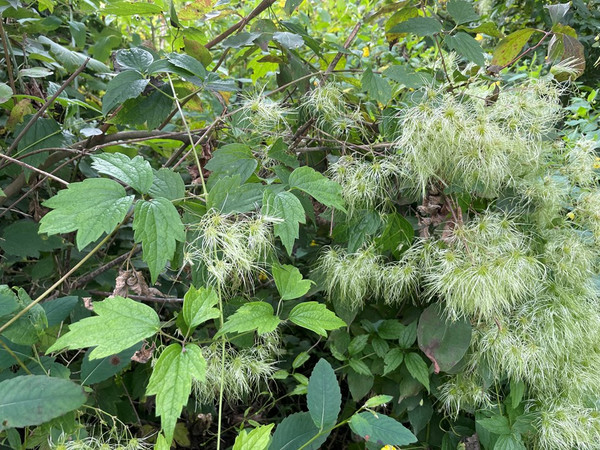
Ecologically, Virgin’s Bower plays an important supporting role. It serves as a host plant for 30+ species of butterflies and moths, helping sustain the insect populations that form the base of the food web. After flowering, the vine produces feathery, plume-like seed heads that persist into fall, giving the plant its signature airy appearance and adding winter interest.
Birds utilize the vine’s dense growth for cover and occasional nesting, particularly where it forms protective tangles along edges and trails. Its climbing habit allows it to create vertical habitat without the need for additional structure.
Historically, this vine was both admired and managed. Its vigorous nature meant it could quickly overtake smaller plants, yet along places like Piney Fork, it was simply part of the natural rhythm—spreading where conditions allowed and retreating where shade closed in.
The name “Virgin’s Bower” is derived from a German legend that a clematis sheltered Mary and Jesus on their flight into Egypt Bower is derived from the Middle English word ‘bour’ meaning dwelling. ■